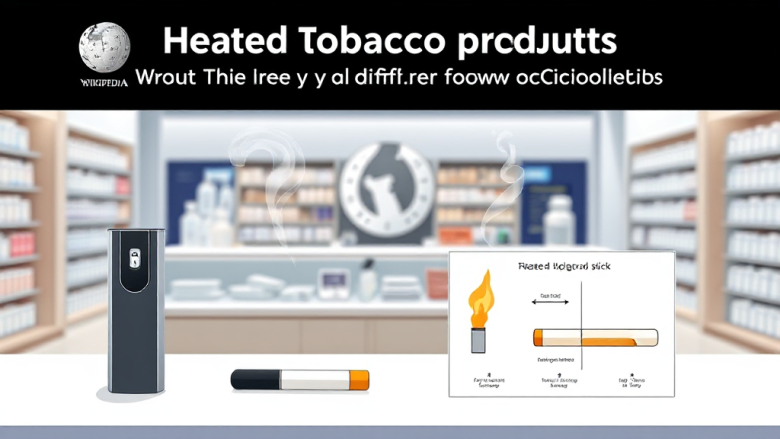
Heated Tobacco Products: What They Are and How They Differ from Cigarettes
What exactly counts as a heated tobacco product, and why does the distinction from burning matter? At its simplest, a Heated tobacco product is a device that warms processed tobacco to a temperature high enough to release nicotine and flavour volatiles, but low enough to avoid combustion. That single design choice — heat instead of burn — is what separates this category from conventional cigarettes and shapes everything that follows: the aerosol chemistry, the device engineering, the regulatory treatment, and the health questions researchers are still working through.
This explainer is written for the science-literate general reader who wants a clear, neutral overview before deciding whether to read further. It is not a buying guide and not a recommendation. The goal is to describe what the category is, how it works, how it differs from cigarettes and e-cigarettes, and where the evidence and regulation currently stand.
Defining the category: heat, not burn
Combustion is a chemical reaction that requires oxygen and produces heat, light, ash, and a complex mixture of gases and particulates. When tobacco burns in a cigarette, temperatures at the tip can exceed 800°C. That heat drives pyrolysis and combustion, generating the tar and many of the harmful compounds associated with smoking. Heated tobacco products take a different path. They operate at lower temperatures — typically in the range of 200°C to 350°C depending on the device — so the tobacco is warmed and volatilised rather than burned.
The practical consequence is that the aerosol produced is chemically distinct from cigarette smoke. It still contains nicotine, and it still contains some toxicants, but the levels of many combustion-related compounds are substantially lower. That does not make the aerosol harmless. It means the exposure profile is different, and the health implications of that difference are the subject of ongoing research.
It is also worth being precise about terminology. “Heated tobacco product” is an umbrella term that covers several device classes, and it should not be confused with e-cigarettes, which heat a liquid rather than tobacco. The distinction matters because the two categories have different chemistry, different regulatory histories, and different evidence bases.
How the devices work and how they differ from e-cigarettes
Most heated tobacco systems share a common architecture: a battery-powered heating element, a holder or main unit, and a consumable tobacco stick or plug. The user inserts the consumable, activates the device, and draws on a mouthpiece. The heating element raises the tobacco to its operating temperature, releasing an aerosol that carries nicotine and flavour. After a set number of puffs or a fixed duration, the session ends and the consumable is removed.
Within that broad design, there are meaningful engineering differences. Some devices use a blade or pin that penetrates the tobacco stick and heats it from the inside. Others use an induction system that heats a susceptor element within the consumable, avoiding direct contact between the heater and the tobacco. The induction approach tends to reduce residue buildup and simplifies cleaning, which is one reason it has become more common in newer generations.
E-cigarettes, by contrast, heat a liquid formulation — usually propylene glycol, vegetable glycerin, nicotine, and flavourings — to produce an aerosol. There is no tobacco leaf in the consumable, and the aerosol chemistry reflects the liquid rather than the leaf. Some researchers treat heated tobacco and e-cigarettes as points on a spectrum of non-combustible nicotine delivery, while regulators often treat them as separate product categories with separate rules.
For readers who want to see how specific hardware and consumable lines are described in the market, examples such as TEREA sticks and IQOS devices illustrate the stick-and-holder model in practice. The key point for this article is structural: heated tobacco products deliver nicotine from heated leaf, while e-cigarettes deliver it from heated liquid.
Aerosol chemistry: what is actually inhaled
The aerosol from a heated tobacco product is not smoke, but it is not clean air either. It typically contains water, glycerin, nicotine, and a range of tobacco-derived compounds. Because the tobacco is heated rather than burned, the aerosol generally has lower levels of certain combustion markers — for example, carbon monoxide, formaldehyde, and some polycyclic aromatic hydrocarbons — compared with cigarette smoke. However, “lower” is not “absent,” and the absolute levels vary by device, consumable, and puffing behaviour.
Researchers use several methods to characterise this chemistry. Laboratory studies typically generate aerosol under controlled puffing regimes and analyse the collected fractions for target compounds. Clinical studies measure biomarkers of exposure in users who switch from cigarettes to heated tobacco products, looking for changes in blood and urine markers associated with combustion. Population studies attempt to track longer-term outcomes, though these are complicated by dual use, product evolution, and the difficulty of isolating one product category from the broader nicotine market.
One consistent finding is that switching completely from cigarettes to a heated tobacco product tends to reduce exposure to a number of combustion-related toxicants. The word “completely” is doing a lot of work in that sentence. Dual use — continuing to smoke while also using a heated product — generally produces a different and less favourable exposure profile than a full switch. This is one reason public health bodies tend to frame the category in terms of substitution rather than addition.
Regulation: how authorities classify and control the category
Regulatory treatment of heated tobacco products varies by jurisdiction, and the variation is significant. In the European Union, heated tobacco products fall under the Tobacco Products Directive framework, which sets rules on ingredients, labelling, reporting, and certain advertising restrictions. The European Commission maintains an overview of how tobacco products are regulated, and readers who want the primary source can consult the EU Tobacco Product Regulation pages for the current framework.
In the United States, the Food and Drug Administration regulates heated tobacco products as tobacco products under the Family Smoking Prevention and Tobacco Control Act. Manufacturers must submit premarket applications, and any modified-risk claims require separate authorisation supported by scientific evidence. Other countries have adopted their own approaches: some treat heated tobacco like conventional cigarettes for tax and advertising purposes, some apply lighter-touch rules, and some have banned the category outright.
For consumers, the practical implication is that availability, labelling, flavour restrictions, and age-verification requirements depend heavily on where you are. A product that is legally sold in one country may be restricted or unavailable in another. Anyone considering a purchase should check local rules rather than assuming that a category-wide description applies everywhere.
If you are exploring the market side of this category, you can browse TEREA products at Puff EU to see how one retailer presents compatibility information and product details. That kind of listing is a useful illustration of how the stick-and-device model is communicated to adult customers, though it is not a substitute for local regulatory guidance.
Health evidence: what is known and what is still uncertain
The health evidence on heated tobacco products sits somewhere between “promising” and “incomplete,” and honest summaries should say so. On the exposure side, studies of users who switch completely from cigarettes generally show reductions in biomarkers associated with combustion, such as certain volatile organic compounds and carbon monoxide. These findings are consistent with the chemistry: less combustion means fewer combustion products.
On the outcome side, the picture is much less settled. Reducing exposure to toxicants is not the same as reducing disease risk, and the diseases associated with smoking — cardiovascular disease, chronic obstructive pulmonary disease, and several cancers — develop over decades. Long-term epidemiological data on heated tobacco products are still accumulating, and the studies that exist are often complicated by dual use, switching patterns, and the fact that the products themselves have changed over time.
There are also questions specific to the category. Nicotine itself is not harmless, particularly for cardiovascular health and adolescent brain development. Some studies have raised concerns about the ultrafine particle fraction of the aerosol and about certain flavour compounds. Regulators have generally taken the position that heated tobacco products are not risk-free and should not be used by people who do not already use tobacco. The most defensible summary is that complete switching likely reduces exposure to many harmful compounds relative to continued smoking, but that this does not establish the category as safe, and that non-users — especially young people — should not start.
Outlook: where the category is heading
Looking ahead, several trends seem likely to shape heated tobacco products. First, device engineering will continue to evolve, with induction heating, better temperature control, and improved consumable design becoming more common. Second, regulation will keep tightening in many markets, with more attention to flavour restrictions, advertising rules, and premarket review. Third, the evidence base will grow, though slowly, as long-term studies mature.
For readers who want to follow the category, the most useful habit is to separate three questions that are often blurred together: what the product is, what the evidence shows, and what the rules allow. A heated tobacco product is a device that heats processed tobacco without burning it. The evidence suggests that complete switching reduces exposure to many combustion-related toxicants, while long-term outcome data remain incomplete. The rules depend entirely on where you are.
If you are considering the market side of this category, you can View TEREA ordering options at Puff EU to see how one retailer structures its product listings, or shop TEREA sticks if you are an adult user who has already checked local rules and device compatibility. Readers who want to compare formats can also browse TEREA sticks at Puff EU to see how consumables are described alongside the devices they are designed for. None of this changes the underlying science: heated tobacco is a distinct category from both cigarettes and e-cigarettes, and its long-term health profile is still being studied.
The clearest takeaway is the one that opened this article. The difference between heating and burning is not a marketing detail — it is a chemical distinction that shapes the aerosol, the regulatory treatment, and the health questions. Understanding that distinction is the first step toward reading the rest of the evidence with a clear head.