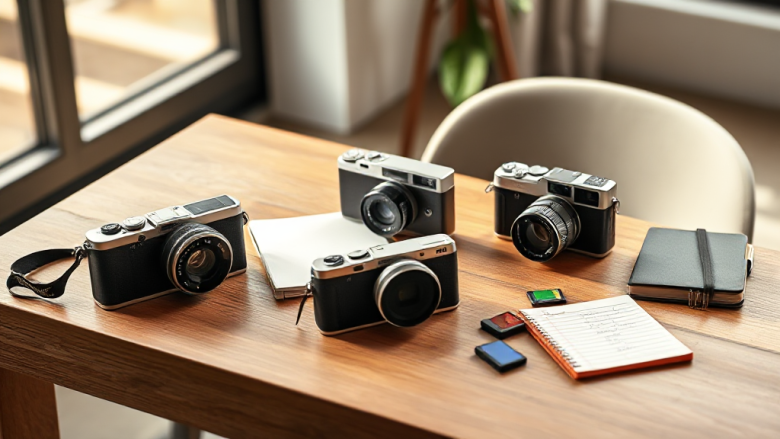
Searching for the best budget cameras for beginners can feel like walking into a maze with no exit. Every review contradicts the next. One person swears by a compact with a flip screen, another insists you need a viewfinder or you might as well use your phone. Specs get thrown around like they settle arguments, and yet none of it tells you what you actually need.
Here’s the thing: the best budget cameras for beginners are not ranked in a single list. They sort themselves by what you want to shoot. A vlogger who talks to a lens all day needs something different from a traveler who wants a camera that survives a backpack. So instead of a top ten, this article groups options by three common beginner profiles: everyday shooting, video-first work, and travel. Each one gets a recommendation and an honest trade-off. By the end, you should know which camp you belong to, and that’s more useful than any star rating.
How to Choose When Every Review Says Something Different
First, accept that at this price point you are always compromising on something. Budget cameras for beginners rarely win on every front. A model with a big sensor might have sluggish autofocus. A tiny body might overheat when you record long clips. The trick is deciding which compromise you can live with.
Ask yourself three questions before you look at a single spec sheet. What will I photograph or film most often? Will I carry this camera every day, or only on planned trips? Do I want to learn manual controls, or do I just want decent results without much fuss?
Those answers matter more than megapixels. A camera that stays in a drawer because it’s too heavy is worse than a cheaper one you actually use. And a camera with confusing menus will frustrate a beginner faster than any technical limitation.
Also, think about the lenses. Some budget cameras have a fixed lens, which keeps things simple and affordable. Others accept interchangeable lenses, which means you can grow into the system later. Fixed-lens compacts are usually the safer first step unless you already know you want to explore different focal lengths.
One more thing: don’t ignore the used market. A previous-generation model in good condition often beats a brand-new entry-level camera at the same price. More on that near the end.
Profile One: The Everyday Shooter
This is the person who wants a camera for weekends, family gatherings, street walks, and the occasional portrait of a friend. They don’t have a niche. They just want photos that look better than a phone snapshot, with more control when they want it.
For this profile, a compact camera with a one-inch sensor and a zoom lens is usually the sweet spot. Something like a Canon PowerShot G9 X Mark II or a Sony RX100 III (both older models now, but still capable) fits the bill. These cameras slip into a jacket pocket, start up quickly, and produce noticeably better images than most phones in low light. They also offer manual modes, so you can learn exposure without diving into a complex system.
The trade-off is zoom range and battery life. Most pocket compacts have a modest zoom and will need a spare battery for a full day out. They also struggle in very dim conditions compared to larger-sensor cameras. But for everyday use, the convenience usually wins.
If you prefer a camera that feels more substantial, a used DSLR like a Nikon D3500 or Canon EOS Rebel T7 with a kit lens is worth considering. These are bulky by today’s standards, but they teach you the fundamentals and have excellent battery life. The catch is that they’re not pocketable, and the kit lens is fairly basic. Still, for a beginner who wants to learn, a used DSLR remains one of the best budget cameras for beginners in the everyday category.
Profile Two: The Video-First Beginner
Maybe you want to start a YouTube channel, record cooking demos, or document your hobbies. For you, video quality and audio matter more than stills. You need a camera that records clean 1080p or 4K, has a flip screen so you can see yourself, and can accept an external microphone.
The Panasonic Lumix G7 is a classic recommendation here. It’s a mirrorless camera from a few years back, but it shoots 4K video, has a fully articulating screen, and takes Micro Four Thirds lenses. You can find it used for a very reasonable price. The autofocus isn’t as reliable as newer models, especially when you’re moving, but for stationary talking-head videos it works fine.
Another option is the Sony ZV-1, a compact designed specifically for vlogging. It has a flip-out screen, a decent built-in microphone, and reliable autofocus. The downside is a small sensor, so low-light video gets noisy, and the battery drains quickly. It’s also more expensive than a used Lumix G7, but it’s simpler to use out of the box.
The trade-off for video-first cameras is often stills performance. Many are optimized for video, so their photo capabilities are average. If you plan to shoot both equally, look for a hybrid model like the Lumix G7 rather than a dedicated vlogging compact.
Don’t forget audio. A camera with a microphone jack is a huge advantage. Built-in mics pick up handling noise and sound distant. A cheap lavalier mic plugged into a camera with a mic input will improve your videos more than any resolution bump.
Profile Three: The Traveler Who Wants Less to Carry
Travelers have unique demands. The camera must be light, durable, and ideally weather-sealed. It should charge via USB so you don’t need a separate charger, and it should be inconspicuous in crowded places. You also want good battery life because outlets aren’t always available.
A used Olympus OM-D E-M10 Mark III or Mark IV with a compact prime lens is a strong choice. These Micro Four Thirds cameras are tiny, have in-body image stabilization, and are built well. The 14-42mm kit lens is collapsible and pocketable. The trade-off is that the menu system can be confusing for beginners, and low-light performance is limited compared to APS-C cameras.
If you want something even simpler, a rugged compact like the Olympus Tough TG-6 is worth a look. It’s waterproof, shockproof, and freeze-proof, which makes it ideal for beach trips and hikes. The image quality is decent but not stellar, especially in low light, and it has a small sensor. Still, for a traveler who prioritizes durability over image quality, it’s a reliable companion.
Another angle: a used Sony a5100 or a6000 with a compact lens. These APS-C mirrorless cameras are small, have excellent autofocus, and produce great images. The a6000 lacks a touchscreen and has a somewhat dated interface, but it’s a workhorse. Pair it with a 16-50mm power zoom lens and you have a versatile travel kit that fits in a small bag.
The main trade-off for travel cameras is often lens selection. Micro Four Thirds and Sony E-mount have plenty of lenses, but good ones cost money. Start with the kit lens and add a fast prime later if you find yourself shooting in low light.
Buying Used: How to Stretch Your Budget Further
Buying used is the smartest move for beginners on a tight budget. Depreciation hits cameras hard, so a model that was mid-range three years ago now costs less than a new entry-level camera. You get better build quality, more features, and often a larger sensor.
But you need to be careful. Check the shutter count if it’s a DSLR or mirrorless camera. A high shutter count means the mechanical parts are worn. Look for signs of impact damage, fungus in the lens, and scratches on the sensor. Ask for original receipts if possible. Buy from reputable marketplaces that offer returns, or from a local shop that guarantees its used gear.
Also, factor in the cost of accessories. A used camera might not come with a charger, battery, or strap. Those add up. Sometimes a new camera with a warranty is worth the extra cost for peace of mind, especially if you’re not comfortable assessing used gear.
One last tip: don’t buy a camera that’s too old. Anything before 2015 might lack modern conveniences like Wi-Fi, USB charging, or decent autofocus. Aim for a model released in the last eight to ten years. That’s the sweet spot for value and usability.
Frequently Asked Questions
What is the best budget camera for a beginner who wants to learn manual controls?
A used DSLR like the Nikon D3500 or Canon Rebel T7 is excellent for learning. They have physical dials, clear menus, and long battery life. The trade-off is size and weight, but for learning, they’re hard to beat.
Do I need a camera with a flip screen for vlogging?
Yes, a flip screen makes a huge difference. Without one, you can’t see yourself while recording, which leads to framing mistakes. It’s one of the few features I’d call essential for video-first beginners.
Is it better to buy a new entry-level camera or a used mid-range one?
Generally, a used mid-range camera offers better value. You get superior build quality and features for the same price. Just inspect it carefully or buy from a seller with a good return policy.
How much should I expect to spend on a budget camera for beginners?
You can find capable used cameras for around the price of a mid-range smartphone. New entry-level models cost a bit more. Set a budget that includes a memory card and spare battery, then look for the best condition within that range.