You don’t need talent to start painting. You need brush mileage. The first canvas is not supposed to be good — it’s supposed to teach your hand how paint behaves. So if you’ve got a cheap set of acrylics and a free evening, here’s the plan: pick one subject from the list below, give it forty minutes, and let it be messy. Each idea teaches one specific skill, so even a wobbly result moves you forward.
Easy Painting Ideas for Beginners That Teach One Skill Each
1. A single tree on a hill. Why: it teaches you how to build a silhouette and how to suggest distance with nothing but value contrast. How: paint the sky first with a flat wash, let it dry, then load a round brush with dark green or black and pull a trunk upward with a few tapering branches. Add a soft grey-green hill behind it before the tree so the tree sits in front, not on top.
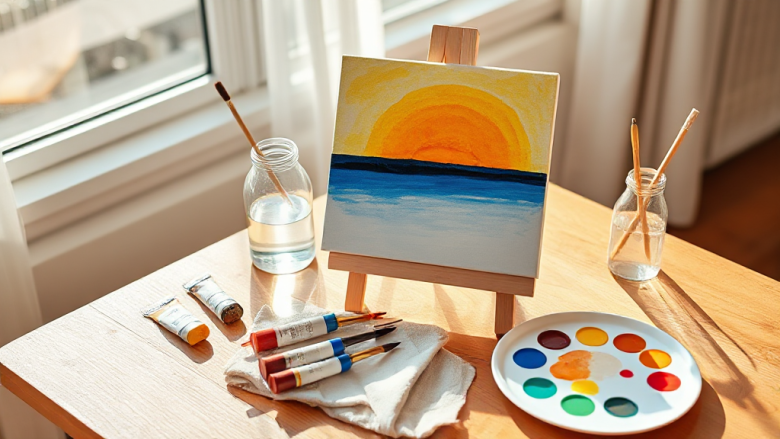
2. A sunset in three bands. Why: it teaches colour blending and how warm colours behave next to cool ones. How: block in yellow near the horizon, orange in the middle, and a deep blue-purple at the top. While the paint is still wet, drag a clean, damp brush across the seams so the edges soften. No detail required. The whole thing takes fifteen minutes.
3. One apple on a plain background. Why: it’s the fastest way to learn how light wraps around a round object. How: paint a red circle, then add a darker red crescent on the side facing away from your imaginary light source. Add a small white highlight where the light hits. A faint grey shadow underneath anchors it to the surface.
4. A row of simple houses. Why: it teaches you to see shapes as blocks rather than as objects. How: paint three or four rectangles in different muted colours along the lower half of the canvas. Add triangles on top for roofs. One or two small squares for windows. Leave the sky empty or wash it pale blue. Straight lines are optional — a slightly crooked roofline looks like a village, not a mistake.
5. A vase of loose flowers. Why: it teaches you to paint suggestion instead of precision. How: sketch the vase shape with a light pencil line, fill it with one flat colour, then dab clusters of three or four small blobs for each flower. Don’t outline petals. Let the blobs overlap. Green stems can be single strokes that don’t quite reach the vase.
6. A moonlit sky with one cloud. Why: it teaches you how to paint light against dark, which is the core of almost every night scene. How: cover the canvas in dark blue or indigo. While it’s still wet, paint a pale yellow circle for the moon and a soft grey shape beside it for the cloud. Blend the cloud edges outward so it looks lit from behind.
7. A cup of coffee seen from above. Why: it teaches you ellipse shapes, which show up in every plate, bowl, and table you’ll ever paint. How: draw an oval for the rim, a smaller oval inside for the liquid, and a curved handle on one side. Shade the outside of the cup with a slightly darker tone. The saucer is just a bigger oval underneath.
8. A path disappearing into trees. Why: it teaches perspective without any measuring. How: paint two lines that start wide at the bottom of the canvas and narrow as they go up. Fill between them with a sandy colour. Add dark green shapes on both sides that get smaller as they approach the vanishing point. The path does the work for you.
9. A bowl of fruit, simplified. Why: it teaches you to group objects and repeat shapes. How: paint three overlapping circles — an orange, a lemon, and a plum, say — then add a curved line beneath them for the bowl. Keep each fruit to two tones: a base colour and one darker edge. The repetition makes the whole thing look intentional.
10. An abstract colour block. Why: it teaches composition and colour balance with zero drawing skill required. How: divide the canvas into four or five uneven rectangles with masking tape, paint each section a different colour, and peel the tape while the paint is still slightly tacky. You’ll end up with crisp edges and a piece that looks deliberate even if you chose the colours at random.
What You Actually Need Before You Start
You can do all ten of these with a small set of acrylics, two brushes, and something to paint on. A flat brush about one centimetre wide handles backgrounds and blocks of colour. A round brush with a pointed tip handles lines, stems, and small details. That’s genuinely enough. If you’ve got a third brush, make it a bigger flat one for skies and large areas.
For a surface, canvas boards are cheap and don’t need priming. Watercolour paper works too if you’re using acrylics thinly. Even a piece of cardboard from a delivery box will take acrylic paint fine — it just drinks more of it. Don’t buy expensive supplies for your first ten paintings. Buy them for your twentieth, once you know which subjects you actually enjoy.
Keep a jar of water and a rag nearby. Acrylics dry fast, which is both the best and worst thing about them. Fast drying means you can layer and fix mistakes within minutes. It also means your brush will stiffen if you leave it sitting for an hour. Rinse it every few minutes and you’ll avoid the one mistake that ruins more beginner sessions than any other.
One more practical note: work on a surface you can tilt slightly toward you. Paint runs downhill, and a small tilt lets gravity help you pull clean lines instead of fighting it. A stack of books under the back edge of your board is enough.
How to Stop Overthinking the First Canvas
The reason most beginners stall isn’t lack of skill. It’s the belief that the first attempt has to be worth keeping. It doesn’t. Treat your first five paintings as practice sheets, not artworks. Nobody frames a musician’s first scales, and nobody needs to frame your first apple.
If you’re stuck choosing between two ideas, pick the one with fewer shapes. A sunset has three bands. A tree has one trunk and a blob. An abstract colour block has no drawing at all. The simpler the subject, the faster you’ll get to the part that actually teaches you something — moving paint around and watching what it does.
Set a timer if you tend to fuss. Twenty minutes per painting, then stop, even if it isn’t finished. Unfinished work teaches you more than overworked work, because overworking is how beginners turn a decent painting into a muddy one. You’ll learn faster from ten quick studies than from one canvas you spent a month on.
And when something goes wrong — the sky streaks, the tree looks like a lollipop, the fruit bowl turns into a pile of circles — that’s information, not failure. The streak tells you your brush was too dry. The lollipop tells you the trunk needs to taper. The circles tell you to overlap the fruit next time. Every one of those lessons is worth more than a tidy result you didn’t understand.
So pick a subject, squeeze out three colours, and start. The paint doesn’t care whether you’re ready. It only cares that you show up and move the brush.