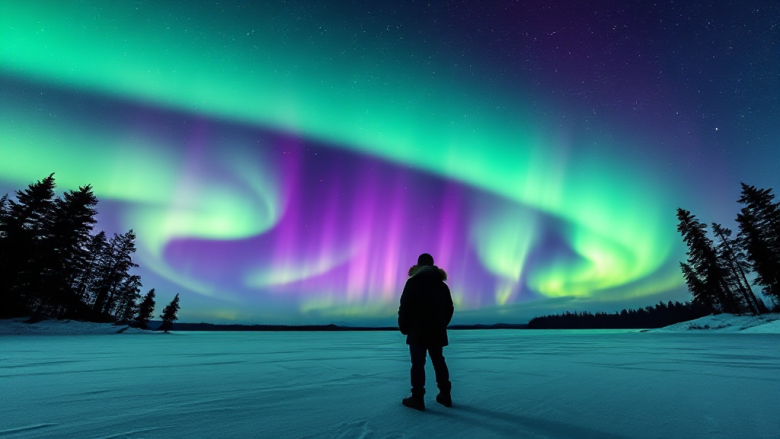
If you want the short answer: the northern lights are most reliably visible between late August and early April, with the best odds from roughly 9pm to 2am local time. That’s the when. But the honest truth is that the real question isn’t just when you can see the northern lights — it’s when, where, and under what conditions. You can stand in the perfect month at the perfect hour and still see nothing but clouds. Get the timing right, though, and you’ve stacked the deck in your favor.
I’ve had nights where the sky exploded green within ten minutes of stepping outside, and other nights where I waited four hours in minus twenty and got a faint grey smudge that barely registered. The difference wasn’t luck. It was the four conditions below, all lining up at once. Once you understand those, planning a trip becomes much less of a gamble.
Best Months Of The Year To See The Northern Lights
The aurora is technically active all year. The problem is daylight. From roughly May to July, the high-latitude regions where the lights appear never get properly dark, so even a strong solar storm is invisible against a bright twilight sky. That’s why the practical season runs from late August through early April.
Within that window, the two sweet spots are around the equinoxes. September and October, and then March and April, tend to produce more geomagnetic activity than the deep winter months. Scientists have noticed for decades that auroras spike near the spring and autumn equinoxes, though nobody fully agrees on why. Whatever the cause, the pattern is useful: if you’re picking a single trip, late September or late March gives you a good balance of darkness, milder temperatures, and active skies.
Deep winter — December and January — has its own advantage. The nights are brutally long, which means more hours of darkness for the lights to show up in. A clear night in northern Norway or Finnish Lapland in January gives you maybe sixteen hours of potential viewing time. The trade-off is cold that bites through every layer you own, and a higher chance of overcast weather. If you handle cold well and want maximum night hours, winter works. If you’d rather not lose feeling in your fingers, aim for the shoulder months.
November and early December can be underrated. They’re dark, often clearer than midwinter in some regions, and cheaper to travel in than the Christmas peak. The one thing to watch is that some northern destinations are still in their rainy or transitional season, so check the local climate rather than assuming all dark months are equal.
Best Time Of Night For Aurora Viewing
The lights don’t run on a schedule, but they do follow a rough daily rhythm. Geomagnetic activity often peaks around local midnight, which is why the hours from about 9pm to 2am are your prime window. That’s when the auroral oval tends to expand and brighten, and when substorms — the sudden bursts that produce the most dramatic displays — are most likely.
That said, don’t treat midnight as a hard rule. Strong displays can kick off at 7pm and fade by 10. Others don’t get going until 1am and keep dancing until dawn. The practical takeaway is to be outside and watching for as much of the dark window as you can stand. Aurora chasing rewards patience more than precision.
One mistake I see constantly: people check the sky for five minutes, see nothing, and go to bed. The lights can be invisible one minute and filling the sky the next. If you’re serious about seeing them, plan to spend at least two or three hours outside, checking every ten or fifteen minutes. Bring a thermos. Bring a chair if you can. Make it comfortable enough that you’ll actually stay.
Also worth knowing: your eyes need time to adapt to the dark. Give yourself twenty minutes without staring at your phone screen. A faint aurora that looks like a grey cloud to dark-adapted eyes can look like nothing at all if you’ve just been scrolling. And a camera will often pick up colour your eyes can’t see, so if your photos show green but you see grey, that’s normal — it’s not a sign you missed it.
The Four Conditions That Must Line Up
Here’s the part most guides skip. Timing is only one of four conditions. All four have to cooperate, and if any one fails, you see nothing.
The first is solar activity. The aurora is driven by charged particles from the sun hitting Earth’s magnetic field. When the sun is active — during a solar maximum, or during a coronal hole stream — you get more and stronger displays. When it’s quiet, even a perfectly dark, clear sky won’t show much. You can’t control this, but you can check forecasts in the days before your trip and pick a window when activity is expected to be elevated.
The second is darkness. No darkness, no aurora. This means avoiding the midnight sun months entirely, and also avoiding bright moonlight if you can. A full moon won’t stop a strong display, but it will wash out a faint one. If you have flexibility, aim for a trip around the new moon.
The third is a clear sky. Clouds are the single most common reason people miss the lights. You can have a once-a-decade solar storm overhead and see absolutely nothing if it’s overcast. This is why location matters so much. Some regions — parts of northern Scandinavia, interior Alaska, northern Canada — have more clear nights than others. Coastal areas often trade milder temperatures for more cloud. If your trip is short, consider a location known for clearer winter skies, or be ready to drive to find a hole in the cloud cover.
The fourth is latitude. You need to be under or near the auroral oval, which sits roughly between 60 and 75 degrees north. That covers places like Tromsø, Fairbanks, Yellowknife, and Rovaniemi. The further north you go, the more often the lights appear overhead rather than low on the horizon. If you’re south of that band, you’re relying on unusually strong storms to push the aurora toward you — possible, but not something to build a trip around.
Quick Checklist Before You Go
Before you book anything, run through this. It takes two minutes and saves a lot of disappointment.
Check the season. Are you travelling between late August and early April? If not, you’re fighting daylight. Check the latitude. Is your destination close to or north of 60 degrees? If not, your odds drop sharply. Check the moon phase. A new moon or a thin crescent gives you the darkest sky. Check the local cloud statistics for your chosen month — not the general weather, but the historical clear-sky odds. Check the aurora forecast in the days before you leave, and again while you’re there. If activity is low, you can still see something, but a strong forecast is a good sign.
And build in buffer. A three-night trip in the right place at the right time is far better than a one-night stop, because a single cloudy night can wipe out your entire chance. Give yourself at least four or five nights if you can. Treat the aurora like a wildlife sighting: you’re creating the best possible conditions, then waiting.
One last thing. Don’t over-plan the perfect night. Some of the best displays happen when you least expect them — on a random Tuesday in October, an hour after you almost gave up. The northern lights don’t care about your itinerary. They care about the four conditions. Get those right, stay outside a little longer than feels reasonable, and you’ve done everything you can. The rest is up to the sky.