Designing Veterinary Dental Interfaces That Professionals Actually Trust
During a dental exam, a veterinary professional is not looking at a blank screen. They are looking at a patient under anesthesia, a clock, an assistant waiting for direction, and a monitor that is supposed to make the next decision easier. In most clinics, that monitor shows a charting grid, a blurry radiograph viewer, and a notes field that was designed for billing rather than diagnosis. The moment is clinical, but the interface rarely behaves like a clinical instrument.
That gap is where AI-assisted dental software can either earn trust or lose it in a single appointment. A company such as nerovet is built around the idea that AI belongs inside veterinary dental workflows, not bolted on top of them. From a product design perspective, the question is not whether the model is clever. It is whether the screen presents the model’s output in a way a clinician can verify, override, and document without breaking concentration.
The scan view: showing evidence before conclusions
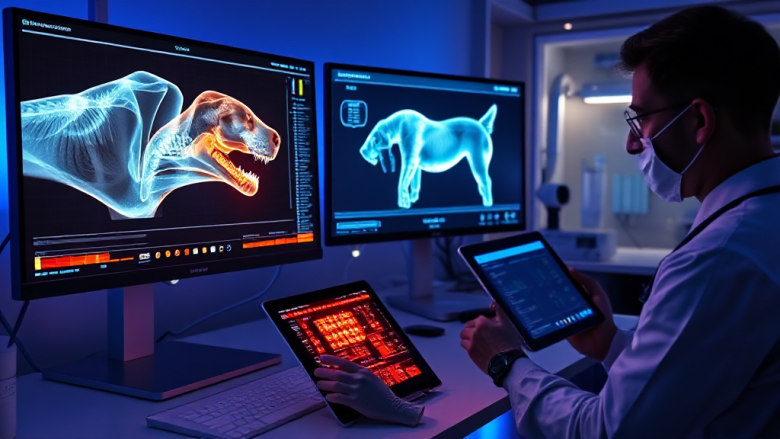
The first interface layer is the scan itself: the radiograph, the intraoral image, or the digital impression of a dog’s or cat’s teeth. Designers often treat this as a viewer problem and stop at zoom and brightness controls. In veterinary dentistry, the scan view is a diagnostic workspace, and its layout determines whether a clinician sees pathology or just pixels.
A trustworthy scan view puts the original image first and any AI overlay second. Overlays should be toggleable, visually distinct from the underlying anatomy, and labeled with plain language rather than confidence percentages alone. If the system highlights a possible fracture on a carnassial tooth, the clinician needs to see the exact region the model is referencing, not a summary badge in a corner.
Annotation that survives a second opinion
Dental findings are frequently reviewed by a colleague or referenced later during extraction planning. Annotations therefore need stable coordinates, a timestamp, and a link back to the source image. When a mark can be moved or deleted without a trace, the interface quietly undermines the record it is supposed to support.
Resolution and latency as trust factors
A scan view that loads slowly or downsamples fine detail teaches professionals to distrust it. Even accurate output feels unreliable when the image softens at the moment of close inspection. Prioritizing full-resolution rendering in the region of interest is a design decision with clinical consequences.
The alert layer: hierarchy instead of noise
Most clinical software fails not by missing findings but by presenting too many of them at once. An AI dental tool that flags every questionable surface will produce alert fatigue within a week. The alert layer needs an explicit hierarchy: critical findings that change the procedure, notable findings worth documenting, and low-priority observations that belong in a collapsed list.
This hierarchy should be visible at a glance. Color alone is not enough for clinicians working under variable lighting, and it is inaccessible to some users. Pair color with position, iconography, and short text labels so the severity of a finding is readable in peripheral vision.
Explaining why a finding was raised
Professionals accept machine suggestions when they can see the reasoning. A short explanation such as a highlighted region, a comparison to the contralateral tooth, or a reference to a similar prior case does more for trust than a numeric score. The explanation should sit next to the finding, not behind a tooltip that disappears on hover.
Dismissal as a first-class action
When a clinician rejects a suggestion, the interface should record that decision and the reason in one step. Dismissal is clinical judgment, not an error state. Treating it as friction teaches users to ignore alerts entirely.
The record layer and the handoff between layers
The third layer is the dental record: the chart, the notes, the treatment plan, and the discharge summary. This is where AI output either becomes useful documentation or evaporates. A finding that cannot be attached to a tooth, a date, and a plan item is not a record; it is a notification.
The handoff between the scan view, the alert layer, and the record layer is the most neglected part of veterinary dental software design. Clinicians move between these layers constantly during a procedure, often with gloves on and limited attention. Each transition should preserve context: the selected tooth, the active image, and the current finding should remain visible as the user moves from diagnosis to documentation.
This is also where AI-assisted veterinary dentistry differs from generic image analysis. The output has to land in a format the practice already uses, whether that is a dental chart, a SOAP note, or a treatment estimate. Interfaces that force a parallel workflow will be abandoned regardless of accuracy.
Design principles worth committing to
- Evidence before conclusion. Show the source image and the exact region referenced before any summary label.
- Layered visibility. Let users hide overlays and alerts without losing the underlying record.
- Severity through multiple channels. Combine position, icon, and text with color.
- One-step dismissal with a reason. Capture clinical judgment as data, not as a dead end.
- Context preservation across layers. Keep the selected tooth and image persistent during documentation.
- Output that fits existing records. Map findings into charts and notes the practice already maintains.
A comparison helps clarify the trade-offs clinic decision-makers face when evaluating tools.
| Interface approach | Strength | Risk |
|---|---|---|
| Overlay-first viewer | Fast to demonstrate | Hard to verify findings |
| Alert-heavy dashboard | High sensitivity | Alert fatigue and ignored warnings |
| Record-integrated workflow | Durable documentation | Requires careful mapping to existing charts |
The closing question for any veterinary dental interface is simple: after the appointment, can the professional explain what the system suggested, why they agreed or disagreed, and where that decision lives in the patient’s record? If the answer requires reconstructing the session from memory, the design has failed the clinician. Platforms such as nerovet are positioned at exactly this intersection of AI and veterinary dental workflow, and the interface is where that promise is either kept or broken.