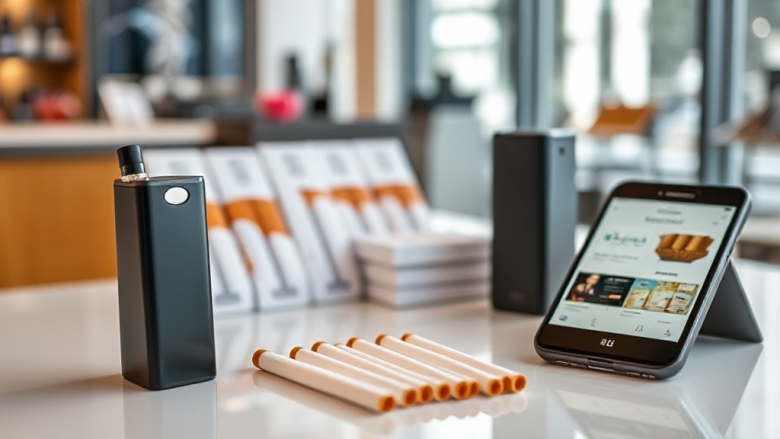
TEREA Under the Lens: Design, Fit and Everyday Handling
Pick up a TEREA stick and the first thing you notice is how little there is to notice. It is short, rigid, and unexpectedly dense for something that looks like a slim cigarette. The filter section has a firm, almost ceramic tap when you roll it between your fingers, and the tobacco end is packed tight enough that it does not shed or crumble. That tactile first impression is not accidental. It is the visible result of an engineering brief written around a single constraint: the stick has to slide into a heating chamber with millimetre-level precision, every single time, and then survive several minutes of internal temperatures that would destroy an ordinary cigarette. If you are comparing formats before buying, the range of terea sticks available across European shops shows how consistently that brief has been executed.
Stick construction: layers, tolerances and the logic of the format
A TEREA stick is best understood as a small engineered assembly rather than a tobacco product with a filter attached. Working from the mouth end, you get a moulded filter, a hollow acetate or paper tube that acts as a cooling and vapour path, a wrapped tobacco plug, and a sealed tip. Each section has a job, and each one affects how the next behaves.
The tobacco plug is where most of the design pressure sits. It is crimped and compressed rather than loosely filled, which gives the stick its characteristic firmness and keeps the material in contact with the heating blade or pin. Contact matters more than airflow here. In a heat-not-burn system, the heat has to travel into the tobacco through conduction, so any gap between the tobacco and the heating element becomes wasted energy and uneven extraction. A loosely packed plug would produce a weak first puff and a bitter final one. A tightly packed plug with consistent density produces a flatter, more predictable curve from start to finish.
The middle tube is the part most people overlook. Its length and internal diameter control how far the vapour has to travel before it reaches your mouth, which in turn controls how much it cools. Too short, and the draw arrives hot and sharp. Too long, and the vapour condenses on the walls before it reaches you, leaving residue behind and thinning the experience. The tube is also where a lot of the condensation collects, which is why used TEREA sticks often look damp inside even when the tobacco itself is spent.
Wrapping is the third layer of the story. The paper around the plug is not standard cigarette paper. It is usually a laminate or a coated sheet designed to resist scorching at the temperatures involved and to hold its shape when the stick is pulled out hot. That is why you can often tap a used stick out of a device without it collapsing, something that would not happen with a conventional cigarette.
Device compatibility: why the fit is the whole point
The TEREA format exists inside an ecosystem. It was developed for the IQOS ILUMA generation of devices, which use an induction heating system rather than the blade-based approach of earlier models. That distinction matters more than most buyers realise. In an induction device, there is no physical blade pushing into the tobacco. Instead, a metal element embedded in the stick itself is heated by an electromagnetic field, and the heat radiates outward into the surrounding tobacco.
This changes the mechanical requirements completely. Because there is no blade to pierce the plug, the stick does not need a hollow channel down its centre. It does, however, need the embedded susceptor to sit in exactly the right position relative to the coil in the device. A few millimetres of misalignment and the heating becomes uneven. That is why TEREA sticks are dimensionally stricter than older stick formats, and why they will not work in blade-based holders. The geometry is not a marketing choice; it is a physical requirement of the heating method.
For the user, this translates into a simple rule: match the stick to the device generation. The reward is a fit that feels almost magnetic. Push a TEREA stick into a compatible holder and it seats with a soft, definite stop. There is no wobble, no need to twist, and no risk of crushing the plug. Pull it out after a session and it releases cleanly, usually with the filter still firm and the wrapper intact.
That clean release is worth dwelling on, because it is where cheap third-party sticks tend to fail. A stick that expands too much under heat will jam. A stick with a weak wrapper will tear and leave paper fragments in the chamber. A stick with a slightly oversized plug will not seat fully, and the device will either refuse to start or produce a thin, unsatisfying session. The tolerance discipline in genuine TEREA production is what keeps the daily ritual friction-free.
Everyday handling: grip, draw and the small ergonomics
In daily use, the TEREA stick is handled far more than a cigarette ever was. You take it out of a pack, insert it, wait for the device to signal readiness, draw, then remove it while still warm. Each of those steps has its own ergonomic texture.
The filter is the main interface. It is firmer than a standard cigarette filter and slightly shorter, which changes how you hold it. Most users end up gripping closer to the middle tube than they would with a cigarette, because the stick is front-heavy when the tobacco end is loaded. The mouth end has a smooth, low-friction finish that sits comfortably between the lips without the papery drag of a conventional filter.
The draw is the other half of the experience. Because the vapour path is longer and the airflow is restricted by design, the pull is tighter than a cigarette. You draw more slowly and for longer. That is not a flaw; it is a consequence of how the vapour is generated. Fast, hard pulls on a heat-not-burn stick tend to produce thin vapour and a hotter mouthfeel, because the air moves through the chamber faster than the heat can keep up. Slow, steady draws give the system time to work.
Session length is fixed rather than variable. The device counts puffs or runs on a timer, and when it stops, it stops. There is no relighting and no stubbing out. For people who liked the natural endpoint of finishing a cigarette, this is familiar. For people who liked to pause mid-cigarette, it is an adjustment. The stick itself is not designed to be reinserted after a partial session, and doing so tends to produce a stale, papery taste.
Removal is the last handling step, and it is where the design shows its polish. A well-made stick comes out with a gentle twist and no residue. The tobacco plug stays intact, the wrapper stays wrapped, and the chamber stays clean. If you find yourself scraping residue out of the device every few days, the stick is usually the culprit rather than the hardware.
Storage: humidity, temperature and the case question
TEREA sticks are more sensitive to storage conditions than cigarettes, and the reason is the same tight tolerance that makes the fit so good. Tobacco is hygroscopic, meaning it absorbs and releases moisture from the air. A plug that has swollen in a humid environment will not seat properly. A plug that has dried out in a hot car will burn hotter and taste harsher, and the wrapper may become brittle enough to crack during insertion.
The practical guidance is straightforward. Keep sticks in their original sealed pack until you are ready to use them, because the foil and the pack lining are doing real work as a moisture barrier. Once a pack is open, try to use it within a reasonable window rather than leaving it loose in a bag for weeks. If you carry sticks around, a hard case is better than a soft pouch, not because the sticks are fragile in the hand but because a case keeps them from being compressed at the plug end.
Temperature swings are the bigger risk. Leaving a pack on a sunny windowsill or in a glovebox exposes the tobacco to heat cycles that soften the wrapper and distort the plug. A cupboard at room temperature is close to ideal. Refrigeration is not recommended, because condensation forms when the pack returns to room temperature, and that moisture goes straight into the tobacco.
There is also a simple rotation habit worth adopting. Use older packs first, and store newer ones behind them. The format does not have an aggressive shelf life, but it is not indefinite either, and the difference between a fresh pack and a year-old one is noticeable in the draw and the aroma.
Wear over time: what the stick tells you about the device
Used TEREA sticks are a surprisingly good diagnostic tool. Look at one after a session and you can read the health of your device and your habits.
A stick that comes out evenly browned from tip to base suggests the heating is uniform and the fit was correct. A stick that is dark at the base and pale near the filter suggests the heat is concentrated at one end, which usually points to a misaligned susceptor or a chamber that needs cleaning. A stick that is scorched or blackened at the wrapper suggests the temperature ran too high, often because the device was used back-to-back without cooling.
Residue tells its own story. A light dusting of tobacco particles in the chamber is normal. A sticky, dark film that builds up over a week is not. That film is condensed vapour and fine particulate, and it gradually insulates the heating element from the stick, which makes each session weaker. Cleaning the chamber every few packs keeps the fit crisp and the session consistent.
The stick itself also changes with device age. As a holder’s internal surfaces wear and the coil degrades, sessions become shorter and the vapour thinner. If fresh packs suddenly feel underwhelming, the stick is rarely the problem. The device is.
Finally, there is the question of counterfeit and low-grade sticks. The visible tells are usually in the wrapper and the plug. Genuine sticks have crisp, evenly printed foil, a clean seam, and a plug that feels uniformly firm when you press it. Copies tend to have softer plugs, looser wrappers, and inconsistent filter density. Because the entire format depends on dimensional accuracy, a small manufacturing shortcut shows up immediately in the fit and the draw. Buying from a reputable European retailer rather than an unknown marketplace listing is the simplest way to avoid that lottery.
Verdict: a format designed around repetition, not novelty
Judged as a piece of product design, the TEREA stick is unusually disciplined. It is not trying to be beautiful or clever. It is trying to be identical every time, in a system where a fraction of a millimetre changes the outcome. The crimped plug, the cooling tube, the laminated wrapper, and the embedded susceptor all exist to serve one goal: a repeatable fit inside a device that heats by induction.
That discipline is also the format’s main limitation. TEREA sticks are not universal. They belong to a specific generation of hardware, and they reward users who respect that. Store them properly, keep the chamber clean, match them to the right device, and the everyday experience is remarkably consistent: a firm seat, a tight draw, a clean removal, and very little mess. Treat them casually, leave them in a hot car or a humid bag, and the same tolerances that make the format work will work against you.
For anyone weighing up the format, the honest summary is that TEREA is a mature, well-resolved design with a narrow but well-defined use case. It is at its best when handled the way it was engineered to be handled, and the difference between a good session and a frustrating one is almost always about fit, storage, and maintenance rather than anything inherent to the stick itself.