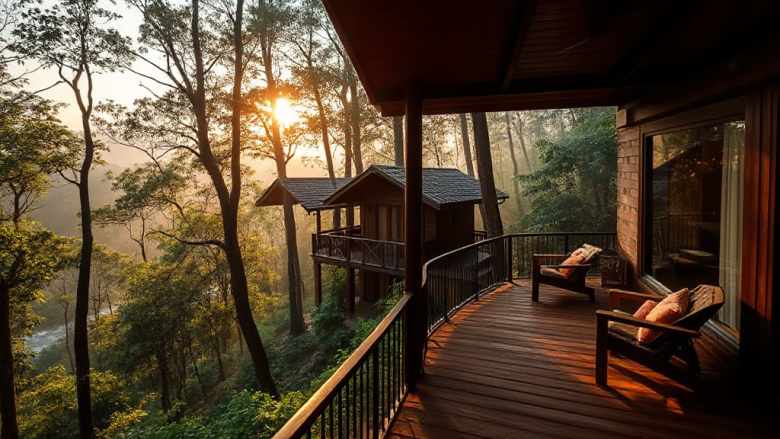
Forest Light and Timber: The Atmosphere of Dandeli Jungle Stays
Arrival at a jungle stay in Dandeli rarely happens all at once. The road narrows, the canopy closes overhead, and then a cottage appears between the trees — not as a building dropped into the forest, but as something that seems to have grown out of the undergrowth. The first sight of that roof line, its material and its angle against the trunks, sets an expectation before you have even stepped inside. This is the quiet design language of dandeli jungle resorts: architecture that listens to the forest rather than competing with it, and light that changes the mood of every wall and veranda through the day.
The first frame: how a cottage meets the trees
What you notice first is usually the roof. In the better jungle stays around Dandeli, roofs tend to be pitched and low, often in tile or treated timber, so they shed the heavy monsoon rain and sit softly against the treeline. A flat concrete block would read as an intrusion here; a steep, textured roof reads as shelter. The walls follow the same logic. Timber cladding, stone bases and earthy plaster all age gracefully in humidity, developing a patina that makes the building look more rooted with every season.
Position matters as much as material. A cottage set slightly back from the path, half-screened by shrubs, feels discovered rather than presented. The gap between two trees becomes a natural doorway; the clearing becomes a courtyard. When you stay at properties such as Golden Eagle Jungle Stay or White Tusker Jungle Stay, the layout is rarely a straight grid of identical units. Instead, the buildings step around existing trees and follow the gentle contour of the land, which is why the first view of your room feels like a small event rather than a check-in transaction.
The veranda is the hinge between inside and outside. A deep veranda with a low railing and a couple of chairs does more for the guest experience than any interior flourish. It gives you a place to sit at dawn with a cup of coffee and watch the mist lift off the undergrowth — a moment that is difficult to manufacture and easy to design for, simply by leaving enough roof overhang and enough open space in front of it.
Forest light, timber grain and the rhythm of the day
Light is the most underrated material in a jungle resort. In Dandeli, the sun is filtered through a high canopy, so the light that reaches a cottage is rarely harsh. It arrives in dappled patches, moving across a wooden floor or a stone wall as the morning progresses. Designers who understand this use large windows and openable shutters to let that moving light do the decorating. A room with a window facing the forest does not need much art on the walls; the forest provides the view, and the light provides the changing colour.
Timber interiors respond beautifully to this. The grain of a wooden ceiling or a polished floor catches the filtered light and warms the whole room, especially in the late afternoon when the forest turns golden. Many of the stays listed through dandeli jungle resorts lean into this palette — honey-coloured wood, muted greens, natural fabrics — so that the interior feels like a continuation of the outdoors rather than a sudden change of subject. Even simple choices, such as a cane chair or a cotton curtain, help the room breathe with the forest instead of shutting it out.
At night the rhythm reverses. Without city glare, the darkness is deep, and the lighting inside a cottage becomes a deliberate, gentle thing. Warm lamps rather than bright overheads, a small light on the veranda, a pathway lit just enough to follow — these details preserve the sense of being inside a forest after dark. Guests often remember this more than the furniture: the feeling of sitting on a veranda with a single lamp on and the sounds of the jungle around them.
This attention to atmosphere is part of why the resort experience here feels different from a standard hotel. Properties like Greenland Junglestay, Old Brook Junglestay and Pepper Paradise tend to be small and spread out, which means fewer buildings competing for the same light and more space for trees between them. The result is a stay that feels private even when the resort is full, because the forest itself acts as the corridor between rooms.
Materials that belong, and the experience they create
There is a practical side to this design language, and it matters to travellers who care about how a place is built. In a humid, rain-heavy region, local and breathable materials perform better over time. Stone floors stay cool, timber breathes, and pitched roofs handle the monsoon without drama. Choosing these materials is not only aesthetic; it is a way of building that suits the climate and reduces the need for artificial cooling and constant repair.
The same logic extends to shared spaces. A dining area with open sides and a high ceiling lets heat rise and air move, so lunch feels airy rather than enclosed. A campfire clearing kept simple, with log seating and a clear sky above, uses the forest as the room. Even the pathways — gravel, earth or stone rather than polished concrete — slow you down and keep your attention on the trees. When you browse the range of stays on dandeli jungle resorts, it helps to look past the photographs of beds and pools and notice these quieter signals: roof shapes, veranda depth, window size and the amount of green left between buildings.
For adventure travellers, the design also shapes the day. A resort laid out with the river and the forest in mind makes it easy to move from a morning of rafting or a nature walk back into a calm, shaded room. The transition from adrenaline to rest is shorter when the architecture is soft and the light is filtered. That balance — activity outside, calm inside — is the real luxury of a jungle stay, and it comes from decisions made long before a guest arrives.
By the time you leave, the details have added up: the first glimpse of a cottage between trees, the dappled light on a wooden floor, the lamp on the veranda at night. Dandeli’s jungle resorts are at their best when they treat the forest as the primary architect and the buildings as careful guests. Choose a stay that respects that relationship, and the atmosphere will do the rest.